
The Children’s Crusade 1212 – Part 1: Stephen of Cloyes

 Castro

 PocketCasts

 RSS Feed

 Apple Podcasts

 Spotify

 Overcast

 Youtube Music
In the late spring of 1212, a spontaneous mass movement of 30,000 children arose in medieval France. Led by a 12-year-old shepherd boy named Stephen from the small village of Cloyes, the “Children’s Crusade” swore to march on the Holy Land and peacefully reclaim the city of Jerusalem from Muslim control. In this first episode of a two-part series, we examine the origins of the Children’s Crusade, the historiographical controversy surrounding it, and the enigmatic figure at its center, Stephen of Cloyes.
SOURCES:
Asbridge, Thomas. The Crusades: The Authoritative History of the War for the Holy Land. Ecco, 2010.
Clayton, Joseph. Pope Innocent III and His Times. Bruce Publishing Company, 1913.
Cunningham, Hugh. The Invention of Childhood. BBC Books, 2006.
Gabriele, Matthew, and David M. Perry. The Bright Ages: A New History of Medieval Europe. Harper, 2021.
Gies, Frances, and Joseph Gies. Life in a Medieval City. Harper Perennial, 2010.
Gray, George Zabriskie. The Children's Crusade. Houghton Mifflin, 1870.
Hourly History. The Crusades: A History from Beginning to End. Hourly History, 2016.
Jones, Dan. Crusaders: The Epic History of the Wars for the Holy Lands. Viking, 2019.
Maalouf, Amin. The Crusades through Arab Eyes. Translated by Jon Rothschild, Schocken Books, 1984.
Nicolle, David. The Fourth Crusade 1202–04: The Betrayal of Byzantium. Illustrated by Christa Hook, Osprey Publishing, 2001.
Norwich, John Julius. Absolute Monarchs: A History of the Papacy. Random House, 2011.
Sayers, Jane. Innocent III: Leader of Europe, 1198–1216. Longman, 1994.
The Crusades. Captivating History, 2019.
Chronicles of the First Crusade. Edited by Christopher Tyerman, Penguin Classics.
Medieval Christianity. Captivating History, 2020.
Trow, M. J. The Children's Crusade. Pen & Sword History, 2008.
Hunnicutt, Wendell, editor. “Speech of Urban II at the Council of Clermont, November 26, 1095.” Reading List: Western Civilization, University of Texas at Arlington, https://websites.uta.edu/hunnicut/reading-list/readings-western-civilization/speech-of-urban-ii-at-the-council-of-clermont-november-26-1095/. Accessed 6 July 2026.
Farkel, William. “The Ebstorf Map: Unlocking Medieval Cartography and Its Hidden Meanings.” The Cartographic Institute, https://thecartographicinstitute.com/the-ebstorf-map-unlocking-medieval-cartography-and-its-hidden-meanings/. Accessed 6 July 2026.
“15 Medieval Jokes That Still Hold Up Today.” Medievalists.net, 23 May 2023, https://www.medievalists.net/2023/05/15-medieval-jokes/. Accessed 6 July 2026
Medievalists.net. (2024, April 17). How to be a shepherd in the Middle Ages. Medievalists.net
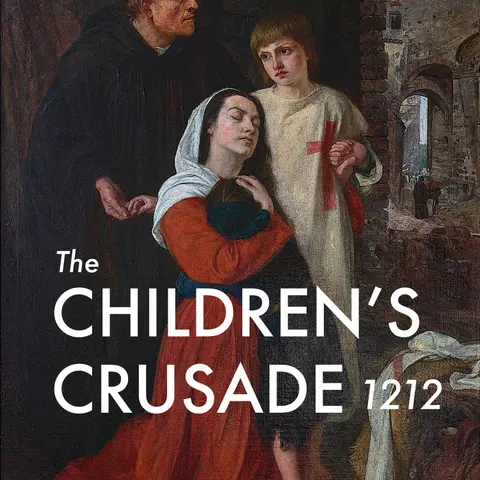
Lanigan, Dennis T. “The Departure – An Episode of the Child's Crusade, 12th Century, by Joanna Boyce Wells.” The Victorian Web, 22 July 2024, https://victorianweb.org/painting/wellsjb/paintings/5.html. Accessed 5 Aug. 2026.
This episode is sponsored by Rula. Rula patients typically pay $15 per session when using insurance. Connect with quality therapists and mental health experts who specialize in you at https://www.rula.com/conflicted #rulapod
Learn more about your ad choices. Visit megaphone.fm/adchoices
==== INTRO =====
Hello and welcome to Conflicted, the history podcast where we talk about the struggles that shaped us, the tough questions that they pose, and why we should care about any of it.
Conflicted is a member of the Evergreen Podcasts Network; and as always, I’m your host, Zach Cornwell.
One of the reasons I love doing this show – and continue to do this show – is because of what an / the incredible, gracious audience I have. And by that, I mean… you. Not a day goes by where I don’t receive some kind of friendly message or sweet note or piece of constructive commentary, and I feel extremely / very, very lucky that you all consider the stuff I’m making worthy of that kind of engagement/feedback.
I also receive a lot of requests. Over the years, more than a few of you have sauntered up to the DJ booth and asked if the show is ever planning on covering this topic, or that topic. And I love those kinds of messages because it pushes me to reexamine my own assumptions about what people are actually interested in learning about. And one of the most common requests I get, is “hey Zach, you should really cover the Crusades.”
THE CRUSADES – BASIC CONTEXT
In the Greatest Hits album of well-known historical conflicts, the Crusades are a topic that most people can at least hum along to. We all know the basics, right? Long ago, in the Middle Ages, Christians from Europe and Muslims from the Middle East fought a series of bloody wars for control of the so-called Holy Land and its coveted crown jewel, Jerusalem. / And its most sacred city, Jerusalem.
“Our God is the one true God!” said the Christians, “and He (capital H) says that Jerusalem belongs to us!” “Ah, what a coincidence,” replied the Muslims, “Our God is the one true God as well! And He says that Jerusalem belongs to us.”
[Unfortunately,] This presented a theological paradox. And perhaps worse, a real estate dispute.
The only sensible thing to do, everyone agreed, was to spend the next two hundred years cutting each other’s heads off. Between the years 1096 and 1291 A.D., eight major crusades were launched, 30-40 battles were fought, and anywhere from 1 to 3 million people died. Like a Hollywood franchise that keeps churning out sequels of diminishing box office returns, the Crusades went on for far too long, cost far too much money, and left everyone involved feeling disappointed afterwards / in the end.
And yet as big and bloody as they were, the Crusades could not be confined to the Middle East or the so-called Saracens therein. [had its fair share of spin-offs and sequels] Aside from the big eight, there were Crusades in Spain against the Moors. Crusades in the Baltics against the Pagans. Even Crusades in southern France against fellow Christians who worshipped the one true God, but not in the one true way. Yes, wherever religious nonconformity reared its ugly head, there were angry men in chainmail eager to solve the matter at the point of a sword.
Suffice to say, that in Medieval Europe, there were all kinds of Crusades for all kinds of reasons. But there is one particular Crusade that doesn’t get talked about very much. Or at least, no one is banging down the doors of Hollywood to make a movie about it.
And that is a little something called the Children’s Crusade.
CHILDREN’S CRUSADE
“Crusade” [of course] is a (an evocative) spring-loaded word. Even brushing against it, triggers an instant barrage of very specific images: Armies slamming into each other under a baking hot sun. Wooden catapults / Siege engines hurling rocks at craggy desert fortresses. Tall knights in rattling armor with bright red crosses sown onto their tunics.
But the Children’s Crusade was something very/entirely different.
The eight major Crusades are recorded in exhausting (and sometimes excruciating) detail. There are entire libraries of chronicles, histories, and research papers devoted to them. Primary sources and secondhand analysis. Enough ink to fill a swimming pool. But everything we know about the Children’s Crusade – the cold hard facts of the matter – could fit / could barely fill on the back side of a cocktail napkin.
The official facts – or [rather] the traditional interpretation, I should say - of the Children’s Crusade is as follows:
In May of 1212 A.D., a large but unknown number of French and German children ran away from home and swore to retake the Holy City of Jerusalem. These pint-sized pilgrims had no Papal support, no paramilitary support, and certainly no parental support, but they marched on nonetheless, with nothing but the shirts on their backs and Jesus in their hearts. They were led, supposedly, by two charismatic young boys. The first was a French shepherd named Stephen of Cloyes. The second was a German boy named Nicolas of Cologne. Over the course of a few short, but turbulent months, the Children’s Crusade traveled hundreds of miles, across France and Germany, over the Alpine passes, and into northern Italy, before eventually ending in failure on the shores of the Mediterranean in September of 1212, just five months after it began. Unable to secure passage to the Holy Land, the Children’s Crusade dissolved like a sandcastle on the beach. The little crusaders scattered, resettled, or just went home. They never made it out of Europe, much less to Jerusalem.
And that – basically – is all we know.
And that… is really all we know.
It is true, as they say, that “history abhors a vacuum”. And so do historians. As the writer M.J. Trow explains:
“Many books on the Crusades do not mention the march of the Children in much detail; some ignore it altogether. That is because it is an awkward event and does not fit easily into any established category. One obvious fact of the other Crusades is that they were fought by armed men, some led by kings or barons. Another is that they had, at the very least, papal blessing and were often instigated by the pope himself. Neither of these applies to the Children’s Crusade.”
Yes, the Children’s Crusade was off-the-books, quite literally. Modern historians don’t like writing about the Children’s Crusade because, frankly/to be fair, there’s not much to write about. As the scholar Gary Dickson puts it:
“The history of the Children’s Crusade is a history constructed out of textual fragments and buttressed by hypotheses. Reconstructing individual case-histories is out of the question. “
When you actually sit down and start tallying up the number of primary sources that mention the Children’s Crusade, it quickly becomes clear that writing a detailed history of the event is a bit like trying to bake a cake armed with only a few handfuls of flour and the vague memory of what cake tastes like/recipe / secondhand description of what cake tastes like. As Dickson continues:
“Out of a total of fifty-six chronicle entries in Latin prose dating from the thirteenth century, fifteen, including replicates, consist of a bare one or two printed lines. These annalistic notices merely label the event, state the year it occurred (oftentimes the wrong year), and nothing more. Next come eighteen, short-to-middling notices of the [children] comprising approximately three to six printed lines. The meatiest chronicles [are] twenty-three relatively extended passages, these run from around seven printed lines to a solid paragraph. Yet here, too, things are not quite what they seem. None of these relatively longer narratives present us with a trustworthy exposition of causes and consequences, let alone a reliable itinerary of the [crusade] from its inception in northern Europe to its termination, not many months later, at the shores of the Mediterranean.”
With such a stark absence of detailed accounts, any serious discussion of the Children’s Crusade is forced to rely on, in the words of MJ Trow, “that most disappointing substitute for the truth, speculation.”
In fact, it’s a minor miracle that we know anything about it at all. It was a Crusade led by nobodies, that went nowhere and accomplished nothing. And yet, this story, vague and frustrating and murky as it is, has somehow managed to come down to us through the merciless Plinko board of history.
“It is,” writes Gary Dickson, “obscurely famous and famously obscure, one of the least understood but most memorable incidents of the crusading epoch.”
And so, all of this leaves a burning question hanging in the air:
How do we know about this? Why does anyone [bother to] remember the Children’s Crusade at all?
MAKING OF A LEGEND
Obscure it may be, but happen it did. And the reason we know it happened is the same reason we know that anything in history happened. People at the time looked out their window, witnessed the event, and thought, ‘man, someone should really write this down; [maybe a podcaster 800 years from now will find this interesting]”
Of course, it’s not just about what’s being written down. It’s about who’s writing it down/doing the writing. And in 13th century Europe, the only people who could write anything besides their names were the clergy – The priests, the abbots, the monks. Literacy was both the burden and privilege of the Church. A sort of consolation prize for a lifetime of celibacy and bad/bland food. As custodians of the word of God, they were the only social class who had any practical use for skills like reading and writing. Sure, there was the occasional urban merchant who could scribble down a note, or a nobleman who preferred to write his own letters rather than dictate them, but by and large, the written word was the exclusive domain of the men of God.
And for that reason, it was the clergy who shaped our initial, fragmentary understanding of the Children’s Crusade. The monks and abbots who looked out their windows and saw an army of children winding its way through the meadows, towns and cities of central Europe were honestly not quite sure how to feel about all this. On one hand, the Children’s Crusade was an act of youthful rebellion, a case of disrespectful/reckless whippersnappers leaving their homes and responsibilities behind. “A foolish and futile expedition,” one chronicler called it. But on the other hand, it was a demonstration of the enormous power of raw faith. Thousands upon thousands of young people charging toward the Holy Land without so much as a butter knife to defend themselves.
It was, in a word, inspiring.
A 13th century Benedictine Monk known only as Renier wrote of a “wondrous movement of children from the French and German kingdoms and chiefly of shepherds, both of the male and female sex. It was their intention to cross the sea and what the powerful and kings had not done, recover the sepulchre of Christ.”
“Everywhere in the villages and fields,” wrote a German chronicler from the Order of St. Augustine, “they left their tools and whatever they had in hand at the time and joined the bands as they passed by. And just as we are often a crowd, credulous in the face of such novelties, many thought this happened not through light-headedness, but by divine inspiration and a kind of piety …’
Contemporary reactions to the Children’s Crusade ranged from indignation to outright encouragement, but all the chroniclers seemed universally stunned by one detail of the movement: and that was the youthfulness of the self-anointed crusaders. Never before had a religious expedition been so dominated by young people, as one anonymous source from Cologne wrote:… ‘many thousands of children from six years old up to the age of manhood (14years) abandoned the ploughs or wagons they drove, or the cattle they herded … and suddenly ran, one after the other, and signed themselves with crosses.’
Wherever the Children went, some monk or priest scribbled down a note about it. In subsequent decades, those notes were picked up and referenced by the next generation of clergymen, who added their own framing and flourishes, and as tends to happen with these kinds of events, a great historical game of telephone began.
“Creative recycling encouraged the migration of texts from one manuscript codex to another,” explains Gary Dickson, “Then, too, pilgrims, merchants, travelling clerics, peasants returning from market, brought rumors and good stories, stirred and mixed with scraps of information.”
Long after the Children’s Crusade had ended, people recounted to each other what they remembered, or thought they remembered. Facts mutated into legend. Creative liberties were taken. As Dickson continues:
“Imagination always exerts a gravitational pull on historical events, bending them into confabulations, fictions, myths. […] “Nowadays what most people remember about it, besides its name, is an image of starry-eyed youngsters pitting themselves against the harsh realities of a pitiless world, exchanging their homeland, their freedom, and their lives for an impossible dream of Jerusalem regained.”
And So, what we are left with today is a story that must be approached with an abundance of caution and several barrels of salt / large pinches of salt. This topic is, at its very core, a blend of fact and fancy, what Gary Dickson called ”myth-history”. As the academic Jane Sayers soberly observes:
“Much of the story of the Children’s Crusade appears to be legend. It attracted later chroniclers who embroidered its importance because of the emphasis on ordinary, simple and poor people providing the answer to the ineptitude of the rich and the powerful — the kings, counts and knights who led the organized crusades.”
And to add a final dollop of confusion to this goulash of ambiguity, there are quite a few modern historians who seriously question whether the Children’s Crusade actually involved children at all. The term for the event in contemporary sources is “Pueri peregrinatio” which is Old Latin for “The Pilgrimage of the Children” or something like “The Wandering of the Boys”. Ah, but here’s the rub/wrinkle. That Latin word for “boys” or “children” (pueri) might also have meant something closer to “servants” or “peasants” in the parlance of the time. So, it’s entirely possible that this was just a mass movement of poor people of normal age, unsanctioned by the Pope, that set out for the Holy Land.
But whatever the exact truth of the matter, something big clearly happened in France in the spring of 1212. Buried somewhere in the musty pages of old books and alcoves of forgotten monasteries, there’s a hell of a good story, one that we will attempt to patch together over the next few hours.
On Conflicted, I don’t typically venture this far back into the past, and when we do it’s certainly not for a topic that’s so fuzzy and ill-defined. Hindsight may be 20/20, but in this particularly case we’re all but / pretty much flying blind. In fact, one could be completely forgiven for asking the question: is the Children’s Crusade even history at all? How can we seriously discuss something we know so little about? Something that is more myth than fact? More bedtime story than historical record?
Well. Challenge accepted.
For me personally, one of the most exciting things about this topic is that it’s not all there in black and white. There are no audio tapes or photographs or autobiographies or news reports. We have to triangulate, infer and God forbid, use our imaginations a little bit.
Just like the little crusaders in 13th century France, we have a destination, but the journey itself - well, that’s up to us.
So, if you’ll indulge me, consider this two-part series] my own humble/meager contribution to the oral storytelling tradition of that weird, wonderful and academically infuriating event: the pueri peregrinatio. And now with all the caveats stated, all the asterisks marked, all the apologies pre-made, we can get started.
Welcome to The Children’s Crusade 1212 – Part 1: Stephen of Cloyes.
==== BEGIN =====
COUNTING SHEEP
It’s June of 1212 A.D.
800 years ago.
We are in the Kingdom of France, the borders of which extend from the shores of the English Channel in the North, to the Pyrenees mountains in the South, to the Argonnes forest in the East. A younger, slimmer version of the nation state that will grace 21st century atlases.
No, right now, the Kingdom of France is more of a confederation than a nation. A loose alliance of feudal lords – key word “feud”. Barons and dukes and nobles and princes who have all grudgingly agreed, for the time being, to bend their armored knees to an aristocratic alpha wolf named Phillip the Second, the King of France.
From his cushioned seat of power in the city of Paris, King Phillip accepts tribute and taxes from all his obedient vassals, sulking in their hundreds of castles across the expanse of France. Rising above the rolling meadows, these castles perch languidly on high hills, watching over the countryside like bored lifeguards.
And between these castles, there are cities. And between these cities there are towns. And between those towns, there are villages. And one of those little villages, is called Cloyes.
That’s C-L-O-Y-E-S (Cloyes).
In medieval France, even the smallest, most remote places can be bustling with activity. On any given day, there can be excitement around every corner, an adventure in every alley, high drama under every low roof. The village of Cloyes is not one of those places. It is a small settlement of small people with small concerns. A predictable, stable place, the euphemist might say. It is, for lack of a better a word, boring. So boring, in fact, that sometimes the only form of entertainment is to simply stare up at the sky and watch the clouds roll by.
Which is exactly what a 12-year-old boy named Stephen is doing right now.
We don’t really know what Stephen looks like. In fact, in the absence of mirrors and reflective surfaces, there’s a good chance even Stephen doesn’t really know what Stephen looks like. But we can use our imaginations; because honestly, if you’ve seen one 12-year-old boy, you’ve seen ‘em all.
We can imagine a mop of sandy brown hair, cut into a bowl shape by a well-meaning but time-constrained mother. We can imagine a freckly face, tanned [cinnamon] by the sun. We can imagine long arms and knobby knees and a flat stomach impervious to calories. And we can imagine brown eyes – brown being the most common color in this place and at this time. We can imagine a smile of teeth that in a later era might require braces. / orthodontal intervention.
And so, in a rolling meadow just outside of Cloyes, 12-year-old Stephen stares into the distance, supporting his weight with a tall wooden stick. It’s a well-known fact of the universe that all little boys love sticks. Finding sticks, comparing sticks, pretending sticks are various weapons. No, there really is nothing as entertaining as a good stick.
But Stephen’s stick is not for playing around. It is for work. That’s because Stephen’s stick is a shepherd’s staff. When you’re a shepherd boy, like Stephen, a staff comes in handy. The curved bit at the top is good for guiding sheep by the neck or yanking them out of danger. The straight end at the bottom is good for keeping your balance as you trudge up steep hills. But the best thing about a staff, at least according to Stephen, is that from a certain angle in a certain light, it looks a bit like a knight’s lance or a hero’s sword.
Peering out over the meadow, Stephen takes stock of his flock. One-two-three, four-five-six, all the way up to fifty. Everyone present and accounted for. Satisfied with the status of his happy little grazers, Stephen is free to enjoy the pastoral beauty of a spring day in the French countryside. As a 14th century shepherd named Jean de Brie described that special time of year:
“The weather is fair and calm and not yet too hot. Everything on earth is in full flower, for then she has put on her beautiful gown, adorned with many lovely little flowers of diverse colors, in woods and meadows – it is then that the pastures are filled with beautiful, tender plants.”
Stephen’s brown eyes move upward from the fluffy white shapes in the field, to the fluffy white shapes in the sky. When you’re a shepherd boy like Stephen, you spend a lot of time by yourself. And although shepherds aren’t supposed to do any daydreaming on the clock, lest a hungry wolf sneak off with one of their lambs, Stephen is still a 12-year-old boy, and occasionally, he allows his mind to briefly drift with the clouds.
The funny thing about clouds, is that when you stare at them too long, they start to look like other things. Up in the cobalt blue, the wisps of cottony condensation begin to take on new forms and shapes. To Stephen, the towering cumulonimbus clouds start to look like imposing castles, brimming with soldiers and ramparts. The slashing cirrus clouds resemble the curved weapons of Saracen raiders. And the long stratus clouds, if you squint a little, look like the fluttering banners of a fearless knight and his loyal retinue.
Stephen of Cloyes was proud to be a shepherd. He really was. It was good honest work for good honest people. It was what he had been raised to do. By 12-years-old, Stephen knew all the finer points of animal husbandry, which did not involve, his father assured him, any long-term romantic entanglements (some of the lonelier shepherds notwithstanding).
Stephen knew everything there was to know about sheep: how to shear them, how to nurse them back to health, how to find one when it wandered off. He knew how to turn sheep fat into candles, how turn sheep bones into soup, even how to turn sheep dung into a poultice. He knew the difference between every ewe, wether, lamb and ram. Yes, Stephen was proud to be a shepherd…but occasionally, in his daydreams, he might’ve wished he could be something else. Something more…exciting.
In our own day and age, little boys and girls grow up wanting to be astronauts or firefighters. Rock stars, athletes, or influencers. There are just certain professions that appeal to the adolescent mind. And kids in the 13th century would’ve been no different. They had dreams too. And in those days, the closest thing to astronauts and rock stars were the noble warrior class - the knights in shining armor. Specifically, knights who took the Cross. The brave crusaders who rode off to the Holy Land to face the wicked Saracens.
The village of Cloyes did not have a local paper, or an evening news channel, so Stephen’s grasp of current events would have been somewhat limited to say the least. But central France was the beating heart of Crusader country, the wellspring of so many knights and heroes and men-at-arms, and Stephen, like most French Christians, would have been very, very aware of the recent wars in the Holy Land. As Gary Dickson writes:
People of medieval Chartres and the Chartrain (which is the area in which Cloyes is located) experienced the crusading movement from the First Crusade (1095) to the mid-thirteenth century, and beyond. It was not something remote; it impinged upon them directly. Exposure to the crusading movement was reflected in a continuing awareness of the Holy Land and its needs, as well as in crusade institutions like the military orders. Returning crusaders shared their experiences with others. The presence of the crusade inhabited the region. Crusade culture in the Chartrain became part of local tradition. Aristocratic families, for example, remembered their kinfolk who journeyed to the Holy Land, shed their blood there, and never returned. […] incessant preaching […] insured that the crusades were an ever-present reality in the Chartrain. A heady atmosphere of crusade ideology and propaganda implanted an awareness of the crusade as God’s cause.”
>
Like most boys his age, Stephen knew that in the year 1095, more than a hundred years before he was born, Pope Urban II – God’s representative on Earth – had called upon the Lords of Europe to retake the Sacred City of Jerusalem. Since time immemorial, Christian pilgrims had been able to peacefully visit the city and pray at the same spot where Christ himself had been crucified. Practitioners of all the major Abrahamic faiths could visit, in fact - Jews, Muslims, Christians – everyone was welcome in Jerusalem.
But then, invaders had swept in from the Eastern steppes, Seljuk (Turk) savages who burned and murdered and defiled the land. They took the city of Jerusalem and restricted access to Christian sites. Returning pilgrims told horror stories of fire, death and religious persecution. Even the Byzantien Emperor, Alexios, begged for military support against the heathens.
They took the city of Jerusalem, kicked all the Christians out, and barred entry to their holy places. Henceforth, they declared, Jerusalem was a city for Islam, and Islam only. And so, across Latin Christendom, swords were unsheathed, chainmail was unrolled and crucifix banners were raised. Great lords and dukes and counts from across Europe combined their forces and marched on the Holy Land. By 1099, they had recaptured Jerusalem and opened its gates for Christian pilgrims once again.
But the Muslim world, sprawling and fragmented though it was, was not content to give up the Holy City without a fight. The gauntlet had been thrown down, and Islam answered in kind. In the decades to come, wars raged across the Levant and Asia Minor and Egypt. By the time Stephen was born in the little village of Cloyes, Jerusalem had been lost (all over again), and three major crusades had failed to bring the Holy Land to heel.
And yet still, knights took the Cross in a vain attempt to recapture what had been lost. Stephen might’ve even seen a few of them occasionally pass through his rest-stop/Shell station of a town on their way to more important places. Tall, strong men in iron helmets, polished to a blinding sheen. They had painted shields slung across their backs, ancestral swords slung low on their hips / long swords buckled to their hips, noble steeds draped in colorful coats-of-arms – a true vision of chivalric perfection.
To Stephen and so many other boys like him, knighthood would have been the ultimate, unattainable fantasy. Like Luke Skywalker staring out at the twin suns of Tatooine, many a shepherd boy or a miller’s son might’ve looked out on the horizon and imagined riding off towards the Holy Land for a great adventure. But alas, the lottery of life had been decided. Just as 12-year-old Zach was never going to become a Jedi, 12-year-old Stephen was never going to become a crusader knight. He would grow up a shepherd, live a shepherd, die a shepherd.
And just like that, the shapes in the sky are gone. There are no more castles or lances or banners. Just clouds. Ordinary, unremarkable clouds. Stephen’s brown eyes drift back down to his fluffy white flock, and again, he counts them up. One-two-three, four-five-six, forty-eight forty-nine…forty-nine…where’s fifty?
Stephen realizes he suddenly has a problem. For a village shepherd boy like Stephen, losing a sheep is not like losing a sock. Up in northern France, with its landed estates and large herds, one sheep may be a rounding error. But in a small town like Cloyes, a lost sheep is a serious threat to one’s livelihood - years of lost wool and milk and mutton. In other words, it is not something Stephen’s father is likely to forgive. God forbid, they might even take away his stick. So, the dutiful shepherd boy sets off to find the wayward member of his flock.
And he doesn’t have to search for very long. / And his search does not last long. On the far side of the nearest hill, by the dirt road that meanders around the village, Stephen finds his lost sheep. The animal is safe and unharmed, but it is not alone. The animal is curled up and sleeping soundly at the feet of a stranger.
An old man that Stephen has never seen before.
There is a rule, commonly held by young children, not to talk to strangers. Stephen, however, is not a young child. He’s 12-years-old – 12 and three-quarters (five-eighths) actually. Almost a man by medieval standards. And although he may not be 14 just yet, Stephen is man enough to tend a herd, man enough to track down a lost sheep, and man enough to talk to a strange person loitering near his field. So, Stephen lifts his chin, puffs out his chest and asks in the lowest tone his pre-pubescent voice can muster:
“Who are you, and what are you doing here?”
THE STRANGER
In that tense and fateful moment, Stephen’s brave question was rewarded with nothing but the sounds of crickets and chirping birds.
“Who are you, and what are you doing here?” Stephen repeated his question to the strange man who had found his lost sheep.
“I heard you the first time,” the Stranger said, not unkindly. “I’m not deaf – just old”
Stephen gripped his staff a little tighter and observed this strange man standing in front of him. It was true, the man was old. He had a beard as white as the sheep curled at his feet. His clothes were old too. Torn and tattered and filthy with dirt. And if a 12-year-old boy thinks your dirty, you’re definitely due for a wash.
But as he appraised the Stranger on the road, Stephen’s deductive powers spun like a wheel. The man didn’t seem to have a weapon, so he wasn’t a mercenary or a brigand. He spoke French, so he wasn’t a foreigner. And he hadn’t made off running like a thief, so either he wasn’t doing anything wrong, or he didn’t intend leave any witnesses.
“That’s my sheep,” Stephen said, doing his best impression of his father.
“Is it now?” The Stranger raised an eyebrow, “I don’t see your name on it.”
Stephen scowled and crossed his arms. “That’s not how it works.”
The Stranger chuckled through a mouth of crooked teeth. “And how does it work?”
Look,” Stephen said, “if you don’t hand over my sheep in the next ten seconds, I’m going to run over that hill, find the village bailiff, and tell him that a smelly old man is out here stealing sheep.”
The Stranger threw up his hands innocently. “I haven’t stolen anything.”
“Not yet,” replied Stephen.
The Stranger furrowed his brow “Do you always treat poor pilgrims this way?”
Are you always this rude to poor pilgrims?
At with that simple word, something woke up in Stephen’s mind. “Hold on a second/Wait,” the boy said, “Pilgrim? You mean you’re on your way to the Holy Land?”
The Stranger laughed and scratched the lost sheep behind its ears. “Going? Son, I’ve been to the Holy Land. I’ve walked its olive groves and seen its deep deserts. I’ve stood on its highest peaks and explored its darkest caves. But…I see that I’ve disturbed you and your flock; I should really be on my way… / I really should be going”
“No no,” Stephen blurted, fumbling in his pockets, “please, sit, relax, stay a while. Are you hungry? I’ve got some bread.”
“Bread sounds wonderful,” the Stranger smiled. “I try and have it daily.”
As Stephen and the Stranger chewed their bread, the lost sheep chewed on a patch of green grass.
“So,” Stephen said after the minimum period of politeness, “What’s it like? The Holy Land?”
“Hot, mostly,” the Pilgrim said through a mouthful of bread. “Full of angry people.”
Stephen’s heart leapt with excitement. “The Saracens, you mean? The Muslims. The infidels. The priest at our parish says that if you kill one, you go to Heaven. The sixth commandment doesn’t apply to them” The boy said this as if he was explaining the difference between heat and cold.
“Do you think you could do that, Stephen?,” The Stranger asked, “Kill a person?”
The boy considered this. “If I had to,” he replied confidently. “Some kinds of killing are okay. Besides, God’s killed loads of people over the years. The Egyptians, the Canaanites, the Sodomites, the Amalekites. Anyone who’s not a Christian.”
The Stranger smiled to himself, as if recalling some private joke.
“And where did you hear about all of that?”
“The Bible,” Stephen beamed, “I know it better than any of the other shepherd boys.”
The Stranger cocked his head, “Oh you’ve read it, have you?”
A shadow/look of embarrassment passed over Stephen’s face. “Well, not read it. I can’t read, per se / exactly. But I pay attention to what the priest says in church, and I have a very good memory. “
The Stranger scratched behind the sheep’s ears and mused, “But/so how do you know what it really says? The Bible? Maybe your priest is lying, or changing the words. Maybe he leaves out the bits he doesn’t like?”
For a moment, a tumbleweed bounced in the space between Stephen’s ears. “That’s not possible,” the boy said sternly, “A man of God wouldn’t do that.”
The Stranger laughed and rose to his knees with a pop and crack of joints, “Young man, trust me / take it from me. There is very little a man of God would not do. In fact, I think that might be the problem.”
Stephen frowned, “What problem?”
The Stranger pointed in the direction of the village. “Men! Women! Adults. Grownups, whatever you wanna call them. They are the problem. Men are weak and vain and brittle. For 100 years they have tried and failed to bring peace to the Holy Land. I think it might be time for a little change in strategy.”
With a magician’s sleight of hand, the Stranger produced some objects from the folds of his tattered robe. They were flat, and beige and covered with inky scribbles. Stephen’s mind recognized them as parchment letters, the kind he’d often seen in the local parish.
The Stranger held out the letters and said “I’d like you to read these for me, Stephen.”
The boy scowled. He didn’t like being mocked or bullied, especially not by an aromatically-challenged homeless man. “I already he told you,” he growled, “I can’t read.”
The Stranger smiled at Stephen as if he were a lost lamb. In the days and weeks to come, the boy would remember it as the kindest smile he had ever seen. “Look again,” the Stranger said.
Stephen rolled his eyes and snatched the letter from the old man’s hand. The boy unrolled the parchment, looked down at it…and fainted.
And as he unrolled the parchment, and started to look at it, a realization sparked. “Wait a second,” Stephen said, “I never told you my name.” And then….he fainted]
==== MUSIC BREAK =====
THE SACK OF JERUSALEM
It’s July 15th, 1099 AD.
One hundred and thirteen years before Stephen the shepherd boy had his strange encounter with the pilgrim outside the village of Cloyes.
And today, at the close of the 11th century, we are very far from the flowery meadows and rolling pastures of central France. We are 2,000 miles to the southeast, beyond the borders of Latin Christendom, past the lands of the Byzantines, deep in the scorching deserts of the Levant.
Today, we are at the center of the world. Not the literal/actual center of the world, of course – but the center of the world as medieval Christians understood it.
Today, we are in the Holy City of Jerusalem.
There are so many different ways to try and understand the mindset and values of people from other times and places. You can look at their clothes, their weapons, their laws. You can look at the music they played, the structures they built, or the food they ate. But one of the most interesting ways to get inside the heads of people from the past, (I think), is to look at their maps.
Long before the days of Google Earth and satellite imaging, people attempted to chart the contours of the world around them with nothing but the naked eye. With quills and brushes and vials of ink, they sketched the boundaries of their reality. Unfortunately, most medieval maps have long since crumbled into dust, but there are a few famous examples that still survive, either in their original form or as reproductions. Mappae mundi, they’re called. Maps of the world.
There’s the famous Ebstorf map, discovered in northern Germany, and destroyed in 1943 during the Allied bombing campaign. There’s the Psalter map from London, and the Hereford map from central England. Each one is unique in its own way. They mark different rivers and cities and landmarks. But there is one common motif that unites them all. At the heart of each map, fixed in the center like a jewel, is the city of Jerusalem.
To European Christians in the Middle Ages, Jerusalem was the center of the world, even though it was a very long way off. You see, medieval cartographers were less concerned with geographic accuracy than spiritual accuracy. Powerful kingdoms like France and England, city-states like Venice and Genoa - compared to Jerusalem these were all just peripheries, spiritual backwaters/boondocks that could not compare in significance to the radiant wellspring of the faith: Jerusalem - the place where Christ was crucified. As MJ Trow writes:
“On the maps of Western Europe, the city was always shown as the center of the world and was assumed, by men who had never been there, to be somehow on a mountain top nearest to God.”
It was, in the colorful words of Pope Urban II, “the navel of the world”. And it was that same Pope who, in 1095, launched the First Crusade in an effort to retake Jerusalem from the Muslim lords who had closed it to Christian pilgrims. Like all talented propogandists, Pope Urban II could turn a phrase and twist a metaphor until it squealed for mercy. As he supposedly told a crowd in 1095, projecting his velvet voice out over his assembled flock:
This royal city, Jerusalem, is now held captive by [God’s] enemies, and is in subjection to those who do not know God, to the worship of the heathens. She seeks therefore and desires to be liberated, and does not cease to implore you to come to her aid. From you especially she asks succor, because God has conferred upon you above all nations great glory in arms. Accordingl,y undertake this journey for the remission of your sins, with the assurance of the imperishable glory of the kingdom of heaven.”
The Pope’s flowery call-to-arms did not go unanswered. A coalition of lords and barons and second sons from all across Europe gathered their best men, marched over the continent and, after rendezvousing at the Byzantine capital of Constantinople, proceeded to invade the Holy Land. One by one, the strongholds of the Levant fell to the Crusader coalition, and by June of 1099, the guards on the walls of Jerusalem woke up to see a host of knights, men-at-arms and mercenaries camped outside their city. The Muslim defenders did what they could to slow the Crusader’s progress – they poisoned nearby wells and cut down trees to deprive the Europeans of materials for siege engines.
But the capture of Jerusalem was as inevitable as gravity, and on July 15th, 1099, the besiegers broke through.
There are many words in the English language to describe what the soldiers of the First Crusade did to Jerusalem. All kinds of benign, tidy little verbs like “occupy”, “seize”, and “pacify/subdue”. The kind of words that barely leave a taste behind in your mouth. But the best word for what the Crusaders did in 1099, I think, is “sack”.
As a noun, of course “sack” means a “bag” or a “pouch”. But as a verb, sack means “to put into a bag”. As in putting stolen gold in a bag, putting human heads in a bag, and if it’s large enough, putting young girls in a bag. After traveling hundreds of miles, after suffering disease, discomfort and the angry arrows of a thousand Turkish horsemen, the warriors of Christ would not be denied their recompense or revenge. The Pope’s eternal gratitude and a reserved seat in Heaven were fine rewards for their efforts, but as the city fell, most Crusaders were looking for something a little more…tactile. A little less “hereafter”, and a little more “here & now.”
And so, the army of the First Crusade sacked the Holy City.
It’s an ugly business sacking a city. If you play your cards right, you can break all ten commandments in the better part of the afternoon. And why shouldn’t they indulge a bit?, the Crusaders told themselves. They’d come all this way, fought all those battles; and besides, the Pope himself had issued them a get-out-of-hell free card. Besides, these weren’t people they were killing. These weren’t girls they raping, or men they were disemboweling/ beheading, or old women they were throwing out of windows just to see the mess they made when they landed. These were Muslims, unbelievers, devils clothed in human skin.
And so, for two whole days in the summer of 1099, the crusaders had themselves a grand ‘ol time in the sacred city of Jerusalem.
Now modern-day crusaders are usually armed with acoustic guitars and Instagram-friendly snippets of scripture. But the crusaders of the 11th century were armed with…well, arms. Pikes and spears and maces. Swords with 3-foot blades that can instantly give you a detailed lesson in human anatomy. Not to mention long coats of iron chainmail and helmets that make it very hard for someone to stop you from these things. As historian Dan Jones writes in his book about the Crusades:
“The slaughter of Jerusalem in the days following its fall to the crusaders on Friday, July 15, 1099, was one of the atrocities of its age, an extreme example of the rights of a victorious party to withhold mercy from the vanquished, and a biblical wasting”
>
Historian Thomas Asbridge elaborates, citing contemporary sources:
Latin eyewitness described how ‘all the defenders retreated along the walls and through the city, and our men went after them, killing them and cutting them down as far as the [Aqsa mosque], where there was such a massacre that our men were wading up to their ankles in enemy blood’ [ …] So gruesome was the carnage that, according to one Latin, ‘even the soldiers who were carrying out the killing could hardly bear the vapours rising from the warm blood’.
“Thousands upon thousands were killed,” continues Dan Jones, “either by the hands of the mob or by their own design, as they leaped from the Temple Mount in despair to escape being tortured to death. Some were drowned in cisterns. Babies ripped from their mothers were smashed headfirst into walls and door frames.”
“But the Frankish massacre was not simply a feral outburst of bottled rage,” writes Asbridge, “it was a prolonged, callous campaign of killing that lasted at least two days and it left the city awash with blood and littered with corpses. In the midsummer heat the stench soon became intolerable, and the dead were dragged out beyond the city walls, ‘piled up in mounds as big as houses’ and burned. Even six months later a Latin visiting Palestine for the first time commented that the Holy City still reeked of death and decay.”
And when there was nothing left to kill, loot, plunder, rape, smash or burn, the crusaders dropped to their iron knees, slick with heathen viscera…and prayed. The same hands that had wrapped themselves around throats and ripped open blouses and crushed little skulls, now steepled together like the walls of a church, and asked for absolution. It was that easy, you see. A little bad behavior on Friday, some light murder on Saturday, and on Sunday morning, you were forgiven. As if nothing had ever happened.
But something had happened. Something big. Something that would bend the arc of history like a copper wire. Jerusalem had been sacked – or “liberated”, as the Pope decreed back in Rome. Through strength of arms and force of belief, the Holy City had been delivered into the gentle hands of Latin Christendom. And there it would remain, the crusaders prayed, for all time and eternity. Of course, it didn’t quite work out that way. There is a reason it’s called the First Crusade and not just The Crusade.
In the afterglow of fall of Jerusalem, the glorious deed was commemorated by artists across Europe, most of whom had never been within 1000 miles of the Holy Land, much less witnesses to the event they were depicting. The two-day massacre was flattened into two-dimensions, cleaned up, scrubbed of blood, and rendered into pleasing shades of gold, indigo and vermillion. In the paintings, the knights glittered like sainted heroes, the evil Saracens trembled before them, and God’s angels smiled down in mute approval. There was none of the unpleasantness, none of the cruelty or hypocrisy. Only the useful bits were left intact. Only the bedtime story remained.
And one hundred and thirteen years later, in the summer of 1212 AD, several of those paintings were still hanging in the halls of the Papal Palace in Rome, the seat of the Roman Catholic Church.
Chapter Four: Innocent III
And looking up at those old paintings, lost in contemplation, is a 52-year-old man named Lothar of Segni. Although, no one calls him “Lothar” anymore. He left that name behind when, at the tender age of 37, the college of cardinals in Rome had unanimously elected him to be God’s highest representative on earth. In the privacy of his own mind, Lothar might still be Lothar; but everywhere else, he is “Pope Innocent III” – His Holiness, the Pontifex, the Lord Apostolic, the heir of St Peter and the Bishop of Rome.
In the absence of photographers and brutally honest portrait painters, it’s more or less impossible to know what Pope Innocent III really looked like. But one of the few depictions we do have, a fresco from around 1216, shows a pale, clean-shaven man with grey eyes, auburn hair and rather large ears that stick out from his Papal tiara.
As Pope Innocent looks up at the triumphant rendering of the First Crusade, he feels a pang of revulsion. Like a sort of mental acid reflux. Not at the horrific violence of the sack, but at how fleeting the accomplishment was. Less than a century after the great victory for Christ, the Muslim lords of the Levant had regrouped, retaken Jerusalem, and reduced the Crusader territories to a handful of port cities clinging to the Holy Land by their fingernails.
Subsequent crusades had been launched, of course; but to no avail. The Second, Third and Fourth Crusades had all been failures – colossal wastes of blood and treasure that only managed to tarnish the reputation of the Church. God has a plan, they say; and apparently that plan did not involve Christian control over Jerusalem.
It reminded Pope Innocent of a popular joke he’d once heard. It went like this: An old man suffering from a long and painful illness is visited by a priest, who hopes to console him. The priest, offering words of comfort, assures the chronically sick man that God, in his infinite wisdom, only tests the people he loves the most. The old man laughs bitterly. That explains then, why God has so few friends.”
Turning away from the painting in disgust, Pope Innocent paces briskly down the corridors of his palace.
In the long history of the Papacy, there have been weak Popes, cowardly Popes, stupid Popes and ineffectual Popes. But Innocent III is none of those things. He is his own animal, and a spry one at that. Compared to some of the wizened old men that will succeed him in the coming centuries, this Pontiff is a young and energetic man, and as he prowls around the Papal residence, his mousey attendants have to speed-walk just to keep up with him.
“Innocent was perhaps the most dynamic holder of Peter’s chair of the entire Middle Ages,” writes M.J. Trow, “Well versed in canon law and the most determined crusader since Urban II.”
Pope Innocent had a simple yet cogent theory of political power – mainly that the Catholic Church should hold all of it. As the self-described “Vicar of Christ on Earth”, Innocent fancied himself the supreme authority in Europe - not kings, not queens; not barons, dukes or counts. Yes, in his own estimation, Pope Innocent was ‘higher than man but lower than God’
Previous Popes might have been content to wield more symbolic authority, feckless figureheads praying on the sidelines, but Innocent believed that it was the Church’s sacred duty to take an active and aggressive role in earthly matters. Anything less was an abdication of the awesome responsibility of his office. Kings ruled over people, but Popes ruled over souls. There was no higher authority, except THE higher authority, of course. And on Earth, someone had to be the adult in the room. As Thomas Asbridge writes:
“Innocent’s aspirations extended well beyond the ecclesiastical or spiritual sphere. Indeed, in his view, the pope should be the overlord of all western Christendom, perhaps even of all Christians on Earth; an arbiter of God’s will whose power superseded that of temporal rulers; capable of making (and breaking) kings and emperors.”
To that end, Innocent had spent his tenure / 15 years as Pope slowly but methodically expanding Papal authority. Like a dynamic new CEO of a tired old corporation, he had taken the reins and assured his heavenly shareholders that Christendom was entering an exciting new era of innovation. He engineered royal successions, crushed pockets of heresy, authored new laws, levied new taxes, and generally put the nobility on notice that if they so much as scratched their royal asses without his blessing, they’d be lining up at the Pearly Gates without a ticket.
Of course, it had not been easy.
Christendom is a large place, and kings do not like being told what to do.
Today, in the summer of 1212 AD, as Pope Innocent gathers his council to discuss the news of the day, it is one problem after another. Sinking into the wooden grooves of his Papal throne, picking a small piece of lint off his cream-colored robe, Pope Innocent holds court and listens to the myriad issues afflicting his Holy Realm.
“The English are at it again, your Holiness,” says one red-robed cardinal, shivering like a lapdog “King John continues to be obstinate.”
“The Cathar heretics are gathering strength in Languedoc, Your Grace,” another scowls, “despite the best efforts of our allies there.”
Yet another Cardinal raises his voice, “the German princes are asking for more concessions, Holy Father. They are not easily placated.”
Pope Innocent holds up his hand, and a heavy silence descends upon the chamber. With Papal authority and divine grace, Innocent asks a question, “Have I ever told you all the one about pregnant woman in Florence?”
The Cardinals exchange furtive glances with each other. All men have vices, even Popes, and everyone knew that Innocent III could not resist the temptation of a good joke. The Pontiff possessed, according to historian John Julius Norwich, “a sense of humor rare in the Middle Ages”. If recent history was any indication, God clearly had a sense of humor; why shouldn’t his greatest servant?
Without waiting for assent from his subordinates, Innocent cracks a boyish smile. “Once upon a time, In the city of Florence, there was a young woman. Somewhat of a simpleton, who was in labor, delivering a baby. She had long been enduring acute pain, and the midwife, candle in hand, inspected her secret area, in order to ascertain if the child was coming. “Look also on the other side,” the poor creature said, “my husband has sometimes taken that road.”
In the stuffy chamber, the Pope’s punchline lands with all the grace of a fallen angel. After an uncomfortably long silence, He claps his hands together. “I realize that wit is a foreign tongue for many of you, but What I am trying to say, my venerable brothers, is that with all these challenges before us, we must be careful not confuse the false path with the true path…”
“Now,” the Pope rubs his temples with both hands, “Does anyone have any good news? (for me today?)”
There is a nervous shuffling of papers and few scattered coughs. Until finally, one cardinal dares to say, “Actually your grace, we have some rather…interesting reports from France.”
Interesting reports from France, thinks Innocent, now there’s an oxymoron. With a flick of his wrist, he signals the Cardinal to continue.
“If reports are true,” the little red sparrow chirped, “the pueri of the farmlands south of Paris – the children - have been seized by a most unusual fervor, unlike anything we’ve ever seen!”
Pope Innocent III narrows his eyes and leans forward in his throne.
“What kind of fervor?”
---- MUSIC BREAK ----
It’s June of 1212 AD.
A few weeks after Stephen the shepherd boy met the strange Pilgrim outside the village of Cloyes. We are 75 miles north of that fateful spot, on the outskirts of Paris, in a small town called St. Denis.
That’s S-T, D-E-N-I-S, St. Denis.
The great thing about small towns, is that they usually have some sort of regional claim to fame, trivial though it may be. It could be an attraction, a monument, a local curiosity – something to bring the tourists in and fill the gift shops.
Nowadays, if you take a road trip through the continental United States, you’ll find hundreds of these little towns. Collinsville, Illinois, for example, is home to the world’s largest ketchup bottle. Mitchell, South Dakota has the famous Corn Palace, an exhibit of murals made entirely of corn. And Riverside, Ohio has a special plaque honoring itself as the future birthplace of Star Trek’s Captain Kirk, in the year 2228.
Well, like these modern roadside attractions, the medieval French town of St. Denis also had a certain claim-to-fame – something that brought the tourists in from miles around. The Abbey at St. Denis – the cathedral – housed a large collection of religious relics – mundane items imbued with theological and historical significance, captured in the Holy Land, and brought back to Christendom for display and veneration.
For a small, entirely voluntary donation to the Abbey’s coffers, you could gain entry to this monastic museum. Look here, the monks say! At the tattered flag that King Phillip Augustus of France carried into battle during the Third Crusade. And over here! One of the iron nails that pinned Jesus to his cross over 1,000 years ago; And right over here, in mint condition, a segment of the crown of thorns that the Romans placed upon his head. And for the true connoisseur – please, please! No touching the exhibit - For the true connoisseur, look here at a tiny strand of hair, plucked straight from the head of baby Jesus in Bethlehem.
Naturally, some people were skeptical about the authenticity of these items. Every little church, abbey and parish from Nottingham to Nazareth claimed ownership of some holy trinket. As one historian commented: “A grove of a hundred oaks would not have furnished all the wood sold in little morsels as remnants of the True Cross; and the tears of Mary, if collected together, would have filled a cistern.’
But for the visitors to St. Denis, any doubts they might have held were quickly dispelled by the knowledge that the relics in the Abbey of St. Denis had been rigorously verified by the Papacy itself, and were determined to be 100%, authentically genuine. Yes, the church town of St. Denis was a treasure trove of religious artifacts…and a boon for the local economy. But on this mid-summer day in 1212 A.D., all those dead relics and dusty curiosities are the last thing on anyone’s mind.
Because just outside the town, the bright green fields are swarming with children. Thousands upon thousandsof children, carrying banners and singing and skipping and praying. As if hundreds of Sunday school classes had suddenly been released into the wild, unrestrained and unsupervised.
CHILDREN ON THE MARCH
>
The townsfolk of St. Denis could only scratch their heads at this strange youthful crowd descending upon their town. The odd part, of course, wasn’t that they were children. Children were not a rare sight in medieval Europe at all; in fact, they were the better part of the population. As Gary Dickson writes:
Like many of today’s underdeveloped societies, thirteenth-century Europe was, despite high infant mortality, “positively teeming with children,” with perhaps around half the population under twenty-one, and a third under fourteen. These are rough estimates, but the impression of a youthful society remains.”
No, the oddest thing about the children gathering outside St. Denis, was just how many of them there were, all in one place. For miles and miles, the procession of children stretched, an endless stream of little faces and big emotions. It was impossible to know exactly how many, but contemporary estimates range anywhere from 5,000 to 30,000.
In the meadows and fields bordering St. Denis, local farmers and passing merchants could not help but ask this parade of singing, skipping children some basic questions: What are you all doing out here? Where are you going? And more importantly, where the hell are your parents?
No matter which child they asked, from the 7-year-olds fighting over whose turn it was to carry the wooden cross, to the older boys and teenagers serving as the rearguard and peripheral sentries, the answer was always the same:
“Stephen is taking us to see the King! He has been chosen by our Lord and Savior Jesus Christ! It is Stephen who will lead us to Paris, who will convince King Phillip to help us, and guide us to the Holy Land to liberate Jerusalem!”
Their curiosity piqued, their heads spinning, the adults continued the line of questioning: And who, exactly, is this “Stephen” person? Is he some noble’s son, a little aristocrat/Lord gone rogue? By what right or title or mandate does he compel you all march? Only the Pope can call a Crusade. In whose name have you come here, and in such vast numbers?
The children shrugged, and laughed, and ran along towards St. Denis, calling back over their shoulders: He’s just… Stephen! Stephen of Cloyes!
THE REVELATION
A few weeks earlier, in the late spring of 1212 AD, absolutely no one had heard of a 12-year-old shepherd boy named Stephen from the tiny village of Cloyes.
And as he laid there unconscious, sprawled out on the dirt road where he had fainted, one of his sheep – the lost one - began to nudge his shoulder. Softly at first, then a bit harder, and a bit harder, until Stephen jerked awake. Gasping and sitting upright, Stephen’s eyes opened wide and scanned the surroundings. The strange old man he had been talking to, the Pilgrim, was gone. In fact, there was no sign of anyone, not even footprints in the dirt. But as Stephen stretched and flexed his limbs, he heard a crackle of parchment, and felt something between his fingers. He looked down to see a thin stack of letters, cradled in his hands.
Like most French shepherd boys, Stephen could not read. He didn’t know Latin from Egyptian from Japanese. But when he looked at the neat little rows of squiggles and shapes on the pages in his hands, he understood. Intuitively. Instantly. Maybe it was the heat, maybe he bumped his head when he fainted, but for some reason…these letters, he could read. It was, in his mind, a miracle.
Leaping up from the ground, sending a cloud dust into the air, Stephen snatched up his wooden staff, shoved the letters into his pocket and ran at a sprint back to the village.
In the hours and days to come, Stephen talked to a lot of people. The other shepherd boys, his friends, children from the village. “His immediate audience,” writes M.J. Trow, “would have been between the ages of eight and fourteen.”
Stephen told these children that he had experienced a vision. A revelation. Well, what kind of revelation? they asked. I met a stranger on the road, Stephen explained, some old pilgrim. At first, I thought he was a beggar or a thief or a bandit. I thought he was going to steal my sheep! But then, Stephen’s voice trembled, he showed me these. They are letters from God. They say that I am supposed to lead a crusade. That I am supposed to travel to Paris and ask for the support of King Phillip himself! And together, not with swords or shields, but the purity of our faith, we will retake Jerusalem!
I know it sounds crazy, but remember what the priest always says at Sunday mass, from the book of Luke: “Let the children come to me, and do not hinder them, for to such belongs the kingdom of God. Truly, I say to you, whoever does not receive the kingdom of God like a child shall not enter it.”
You understand what this means, right? Stephen told his audience, You and me, all of us – God has chosen us to be crusaders! Just like the knights and kings from the stories. But our crusade will be different. We will do what the adults have failed to do so many times. Just imagine it, guys - six months from now, all of us will be together in Jerusalem, praying at the Church of the Holy Sepulcher. Our names will be stitched into tapestries, our faces will be carved into stone, and our devotion to God will be inked into the pages of history!
Now, if I had said these things to my friends when I was 12-years-old, I probably would’ve been excommunicated to the far edge of the lunch table or God forbid, the front of the bus. But the children of the 13th century were not the children of the 21st …When they hear that their friend has had a revelation from God, and that he has been given letters from Heaven to take to the King of France, they believe him. As MJ Trow writes:
“We know that the thirteenth century, indeed, the Middle Ages generally, were thirsty for the miraculous. [it was] the age of miracles.”
And after that, things began to happen very fast.
Those kids told their friends, and those friends told their friends. In a matter of weeks, a rumor became a story became a rock-solid truth, and it spread from hamlet to village, and town to town. All over France, young people dropped their tools, abandoned their chores, and began amassing around this 12-year-old prophet. Before long, Stephen the shepherd boy had a much larger flock - hundreds, then thousands of children, ready to follow him to Paris.
Now, this is the point in the story where the modern mind’s capacity for suspension of disbelief tends to hit a brick wall, if it hasn’t already. But to understand the scale of this response to Stephen’s claims, we have to remember that childhood in the Middle Ages was not easy, or simple, or comfortable. As M.J. Trow writes:
“If the majority of the children were laborers, they would have known the grim hardship of country life, the back-breaking work in the fields, the obsessional reliance on the harvest. And they would have had the influence of the Church. All their news, in an age before mobility, literacy and media coverage, reached them from the pulpit. They were baptized days after their birth. They married in the same church and when they died, they were laid out in the churchyard. It was a cyclical existence, shaped largely by the weather and it was very narrow in terms of geography. Saints’ days were special, a chance to escape, however briefly, from the daily grind. And when the local priest told them about the miracles of Jesus and his saints, they believed every word.”
To a child’s mind, the idea that they could set aside their daily chores, run away from home and go on a great adventure for God would have been almost irresistible. So, when Stephen of Cloyes called on them to march almost 100 miles north to Paris, they answered en masse. As one historian put it: “Armed with celestial letters, and fortified by his story, the charismatic Stephen of Cloyes became God’s postman.”
“Together with his fellow shepherd-boys,” writes an ecclesiastic source from the 1230s, “nearly 30,000 people congregated around him from diverse parts of France.’
Yes, Generation Crusader, “Gen C”, let’s call them, was on the move.
It wasn’t all children, of course. By this point, there were almost certainly adults marching alongside the prepubescent pilgrims, everyday laborers and farmhands who were inspired by Stephen and his mission. Although in the Middle Ages, the definition of ‘adult’ was much broader than it is now. Boys over the age of 14 and girls over the age of 12 were considered “adults”, so to modern eyes, this crowd would have looked very, very young. As Gary Dickson writes:
“The Children’s Crusade was not, possibly never, composed exclusively of young people. Nevertheless, nearly all the chroniclers single out the youthful pueri [latin for boys] as its core group, as well as its most visible and most remarkable element. At the sight of these young people marching off to the crusades, we can almost sense the amazement of spectators and chroniclers alike. [but] unquestionably, the peregrinatio puerorum [the pilgrimage of the boys] was a youth movement. […] “First and foremost, the Children’s Crusade was a revivalist mass movement, a community of believers on the march.”
>>
And sometime in June of 1212 A.D. this massive procession arrived in the town of St. Denis, about 10 miles outside of Paris. We are here, they proclaimed in voices that had yet to drop, to see the King.
IN THE COURT OF KING PHILLIP
The King in question was a 46-year-old man named Phillip (Feh-Leep) the Second.
Although he prefers to be called Phillip Augustus – “Phillip the Great”.
It is a title he has certainly earned in his 32-year rule as King / It is a title he has worked very hard to achieve in his 32-year rule as King; Many a quill has been dipped in ink to chronicle the achievements of the prolific French monarch, from his wars with England, to his expansion of royal lands, even more unsavory acts like the expulsion and persecution of French Jews. Suffice to say, Phillip Augustus is a very powerful, very dangerous man.
And as the youthful mass of humanity swells to immense proportions outside Paris, a nervous courtier in frilly robes skitters across the stone floors of the Royal residence. Huffing and puffing as he goes up the spiral steps two-at-a-time, the servant eventually arrives at the oak door to the King’s chambers, and with a polite little knock requests entry, which is duly granted.
Looking up from his stack of parchment, the King asks what the courtier wants. It’s been a long day, my joints ache, and the summer heat is stifling. In other words: Spit it out, man. What the fuck do you want? Mumbling as fast as he can to deliver his news, the courtier explains what is happening outside the city. When he is finished speaking, there is a moment of terrible silence, and then…King Phillip bursts out laughing. It is not a happy laugh. It is a raspy, scornful, bitter laugh/thing. The kind of laugh reserved for tragedies and bad jokes.
The King spits a wad of phlegm onto his own floor.
“So”, he says, “they want to go to the Holy Land, do they? The little children want to go on a crusade? By all means, let this this “Stephen of Cloyes” come to me. Bring him here – today. We’ll sit down for a little chat, and I will explain to him what crusading really is.”
A few hours later, the front doors to the Royal residence shriek on their hinges. Standing in the entryway, silhouetted against the summer sky, is the four-foot, five-inch figure of Stephen of Cloyes. Clutching his shepherd’s staff in his left hand, and the precious letters from God in his right, Stephen follows the courtier down the hall.
A month ago, the largest and most impressive structure Stephen had ever seen was the local church in Cloyes, a glorified barn with a shabby wooden cross nailed on top. But now, he was here beneath the spires of St. Denis, in the shadow of the walls of Paris, a few short steps from being in the presence of the King of France himself. Stephen’s breath is quick and shallow, his heart is racing, but he tries to remember that Phillip Augustus is just a man. Stephen and his followers serve a higher power, and a higher purpose. Besides, all he has to do is place the letters from God into the King’s hands, and Phillip will understand. Soon, everything will fall into place.
After what seems like the opening and closing of a hundred doors, the courtier opens the final threshold, and Stephen steps into a large and cavernous hall. The place seems empty. There are no tables of feasting nobles, no crowds of lords and ladies, no jesters or musicians, there’s just a man, in a chair, in a room, dimly lit by flickering candles.
Stephen had seen depictions of Kings before. In frescoes and paintings, even on coins. He assumed that all kings were proud and impressive figures, with long robes, glittering armor, and crowns of gold atop their head. But that is not what he sees in front of him. Phillip Augustus looks more like a scarecrow than a King. He is a lean, hard and slender man, draped in a simple tunic – with gaunt cheekbones and a chestnut beard clinging to his face like moss. His skin is tanned and weathered, but his eyes are as pale as cold wax.
“They say,” the King barks, “that you are just 12 years old.”
Stephen’s hand tightens on his staff, and he raises his chin. “12 and three quarters, actually”
The King laughs. The kind of short, sharp laugh that sounds more like a cough.
“I have cysts older than you.”
Ignoring the remark, the boy steps forward and raises the letters in his trembling hand; But as Stephen starts to explain his purpose and mission to the King, he is immediately cut short.
“Yes, yes, yes,” King Phillip snaps, “I know all about your story. The stranger on the road. The letters from God. The miracle, the message, the mission to the Holy Land. I am aware.”
Holding the letters tight to his chest like a teddy bear, Stephen’s confidence deflates. He tries to think of something to say, anything, but his mind is a blank.
“Now, Stephen of Cloyes,” says Phillip, rising to his feet, “let me tell you a story.”
Standing at his full height, the lanky King towers over the boy. “I was a crusader once,” he says, “Did you know that? This worn-out old king was once a warrior galloping sword-in-hand to the Holy Land. I was young, then – not as young as you, of course. I would’ve been, 24? 25 years old? That’s something you’ll discover, Stephen. As you get older, you stop counting birthdays. It’s depressing.”
Phillip cracks his knuckles to ease his joint pain.
“Those were the good old days. My back was straight, my legs were strong, my cock worked on command. Yet another adult priority you’ll soon become acquainted with, Stephen. Thirteen hits us all very hard. But I digress. A little over 20 years ago, around the year of our Lord 1189, I took the cross. I was a young King then – barely a decade on the throne. Quick to anger and eager to please. And when His Holiness Pope Gregory called on me and the other Kinds of Christendom to march upon the Holy Land, I answered. The city of Jerusalem had fallen, you see? After almost a hundred years of Christian control, the Saracens managed to crack the armies of Antioch and Tripoli and retake the Holy City.
Loping over to a table, Phillip grabs a hunk of bread, tears it in half and tosses it to Stephen.
“You cannot imagine the wailing here in France,” he continues. “Every pastor, priest, and parishioner was halfway up my royal ass demanding that I join the Third Crusade to rectify this catastrophe. So, I did, Stephen. I raised the oriflamme (golden flame) banner, I gathered my knights, marshalled the men-at-arms. I kissed my pregnant young Queen goodbye, and set off on an adventure. First, we marched to Genoa, then to Sicily, and then boarded boats to cross the Mediterranean.” The King turns on his heel. “That’s a sea, by the way.”
“Have you ever seen the ocean, Stephen? I suppose not. Imagine, if you can, a body of water so massive, so endless, that all land vanishes beyond the horizon. Imagine waves higher than this abbey, strong enough to crack 80-foot ships like an egg. You have no idea how many would-be crusaders are currently being picked apart by crabs on the ocean floor.”
The King washes his bread down with a gulp of red wine. Wiping his chin on his sleeve, Phillip continues:
“…Eventually, of course, our ships made it to the Holy Land. We splashed ashore, smelling like salt and dead fish and looking crazier than wild dogs. But thankfully, most of my men survived the journey, all of our weapons and armor and horses and supplies. We felt that sacred sand between our toes and found the courage to carry on. From there, we laid siege to the fortress port of Acre, a very important city on the coast. Capturing it would mean controlling a key point of entry to the Holy Land, a safe place for more crusaders to land,and so we surrounded it completely. Like hounds circling a stuck boar, Stephen, we had the Saracens trapped.
Oh, you should’ve seen me back then. 25 years old, top of my game, commanding that army like Caesar himself. I built siege engines and catapults and battering rams. We hurled stones and flaming pitch over the walls, we filled the sky with arrows, and little by little, we wore the infidels down.”
Plucking a handful of grapes out of a bowl, Phillip tosses a few at Stephen. The boy, caught up in the King’s story, cannot help but giggle.
“But war is not a game.” The Phillip’s expression darkens. “It is like the weather. It can turn on you. About a month after we arrived, a strange sickness swept through our camp. Some sort of disease. Arnaldia, the physicians called it. I myself was afflicted by it. Maybe it was the devil trying to stop us, or God trying to humble us, but we all fell down with fever. A burning, ripping hot fever. I saw grown men, trained knights twice your size, beg for their mothers; I saw boys younger than you shit their guts out until they weighed less than a sack of grain. As for me,” the King says, “my hair started to fall out. My fingernails and toenails fell out. My teeth got so loose I could pull them out of my gums like berries off a vine.
And in that moment, so angry and alone and far from home, I thought I was going to die. Another idiot martyr for Christ. But…somehow, I survived. The fever passed, the sickness lifted, and soon after, our allies arrived with fresh troops. And after a two-year siege, the city of Acre surrendered and the oriflamme banner flew over its walls.”
“But don’t think our victory cost nothing…Oh no – God always extracts his pound of flesh. In the end, we lost six archbishops, twelve bishops, forty counts, five hundred nobles and 15,000 soldiers. These were friends I had known my whole life, Stephen; men I had grown up with and played with, left dead and rotting on the hot sand.”
Listening to the King’s story, Stephen of Cloyes feels like his feet are nailed to the floor. The King continues
“After the fall of Acre, there were many nobles who wanted to capitalize on our momentum and march on Jerusalem itself. They banged their swords against their shields and bayed for more heathen blood. But not me, Stephen.”
The King sinks back down into his chair.
“With the victory at Acre, I considered my vow fulfilled. So, I gathered up all my knights – the ones that were left, anyway; put them back on the boats and sailed home to France.
They called me a coward, of course. They called me foolish and treacherous and ungodly and all those things. But I’d had enough of the Holy Land. Nothing less than a visit from Gabriel himself would convince me otherwise. And after all that, what do you think my reward was for going on Crusade? How did God bless me for those long months of fighting and suffering and shitting myself raw? Well, I returned home to France to find out that my wife Isabella had died in childbirth while I was away, and our twin babies along with her. And it didn’t end there. Heretics were rising in the south, the English were plotting against me, and all my problems had simply multiplied in my absence.
The King crushes a grape between his fingers.
That was my reward, Stephen. An empty bed and an empty castle at the end of an empty little war. Because when you take the cross, it takes so much from you in return.”
“So,” The king leans forward, leveling the full force his glare down at the shepherd boy, “Now that you have heard my sad little story…do you still want to go the Holy Land?”
After a brief pause, Stephen responds with a voice that is almost too soft to hear. Phillip barks at him to speak up, boy for heaven’s sake. “Yes,” Stephen says a little louder, crossing his arms “I’m still going to the Holy Land. We all are. With or without your help.”
The King rubs his chin.
“Interesting. You’re not only naïve, but stupid as well. Stephen, please don’t make the mistake of thinking that I care what happens to you – to any of you. I do not. The Saracens can geld you and take you as harem girl, for all I care. But what I do care about, is the peace and stability of my kingdom; and 30,000 prepubescent fanatics turning France into their own personal playground is not my idea of stable. You are causing problems, kid. Fields are not being plowed, seeds aren’t being planted, sheep aren’t being shorn. My nobles are not happy. And when my nobles aren’t happy, I’m not happy.
King Phillip picks something scabby off his arm, inspects it, then flicks it onto floor.
>
“Besides, he says, “you’re forgetting one very important thing: Only the Pope can call a Crusade. Unless His Holiness Innocent III in Rome personally endorses your little expedition, you and all your followers are unsanctioned, unsupported, and unprotected. Little more than heretics, really. And we all know what happens to heretics.”
Leaning on his staff, Stephen scowls with the defiance that only a 12-year-old boy can muster.
“You’re just trying to scare me,” he says, “And you’re forgetting something too. I have something better than the Pope’s permission.” He holds up the letters, “I have these.”
“Ah yes,” the King scowls, “The holy letters. And what do they say, shepherd boy? Please read them for me.”
Without looking down, Stephen recites the words that have been burning in his mind since he fainted on the road. “They say that God has chosen me. That I will perform miracles in His name. That I will lead these people to the shores of the sea. That the waters will part, and that we will walk through the gap like Moses to the Holy Land. They say that the walls of Jerusalem will crumble before us, that the Saracens will scatter and the Holy City will reenter the Kingdom of Heaven.”
The King is silent for a moment before speaking.
“You know, when you first came in here, I thought you might be a charlatan. A clever little con-artist. No different from the boys in the Paris gutters who scam tourists with balls and tricks and cards. But you really believe, don’t you?”
Stephen says nothing and holds the King’s stare.
“Very well,” grunts the King, “Bring me the letters. I’d like to read them for myself.”
Cautiously, as if handling an infant or a glass egg, Stephen passes the holy letters to King Phillip. The King, very slowly, very respectfully, takes the parchment into his hands. They rustle gently between his fingers as he examines them, his eyes scanning back and forth across the page. And then, he starts laughing. Softly at first, then louder, and louder, until he collapses into a coughing fit. By the time he stops laughing, his jaw hurts and he has tears in his eyes.
And In the cold silence of the hall, the King looks at Stephen.
“Would you like to know what they really say?”
And then, as easily as crushing a butterfly, Phillip crumples the letters in his hands. Stephen gasps involuntarily, and before he can register what is happening, the King has hopped up from his chair, walked over to the fireplace, and thrown the holy letters into the flames, where they twist and sputter and crackle into black ash.
“Go home, Stephen of Cloyes,” the King mutters. “Go back to your fields and your sheep and your shitty little life. And if you care at all for the lives of the flock you’ve gathered out there, send them home too. Or, go to the Holy Land and die screaming for all I care.”
Either way, we’re done here.”
With a flick of his wrist, the King motions for his guards. Stephen feels a hand on his shoulder and in a fugue state he is led out of the hall, through the doors, and into the blinding light of day.
As he shuffles back to the pilgrim’s camp, Stephen of Cloyes is surrounded by dozens of his followers. Boys that have been with him since Cloyes. Speaking fast and all at once, they tug at his robes and bombard him with questions. What did he say, they ask? What did Phillip say? Did he read the letters? Will he help us? What do we do next?
Stephen, as if waking up from a catatonic state, suddenly sees the huge crowd of people around him. He sees their wide, hopeful eyes. Their expectant faces. He sees the wooden crosses in their hands and the pure, pleading faith in their expressions.
Not wanting to meet their gazes, he looks up at the sky, searching for the comforting shapes of clouds. He looks for knights, for castles, for horses and ships. He looks for churches, for crosses, for Popes and angels. He looks for any sign at all.
And yet, on this hot summer day, there is not a cloud in the sky.
==== OUTRO =====
Well folks, that is all the time we have for today.
Next time, in final installment of this series, we will examine the second phase of the Children’s Crusade, and its next enigmatic leader, a German boy named Nicolas of Cologne.
And while this episode was mostly confined to the Kingdom of France, the next chapter in our story will take us on a long and twisty travelogue across Europe. From the grimy cities of Germany, to the frigid slopes of the Alps, to sun-bathed palazzos in Italy, the Children’s Crusade is going to cover a lot of ground before ending, as these things tend to do, in tragedy.
So goodbye for now, thanks for listening, and I hope you have an awesome day.
This has been Conflicted.
I’ll see you next time.

